.webp)

Iron & Sulfur Filtration System
For rust-orange staining, black manganese streaks and the rotten-egg smell — chemical-free air injection, sized to your test.



The short answer
- Quoted after testing: Iron and sulfur systems carry no published price, because media type, tank size and backwash frequency all follow your iron and manganese numbers and your household's flow rate.
- The five milligram line: Penn State Extension's practical ceiling is that a softener handles iron on its own only to about 5 mg/L, and only while that iron is still dissolved.
- EPA aesthetic standards: EPA's secondary standard is 0.3 mg/L for iron and 0.05 mg/L for manganese, and secondary standards are aesthetic: color, taste, odor and staining.
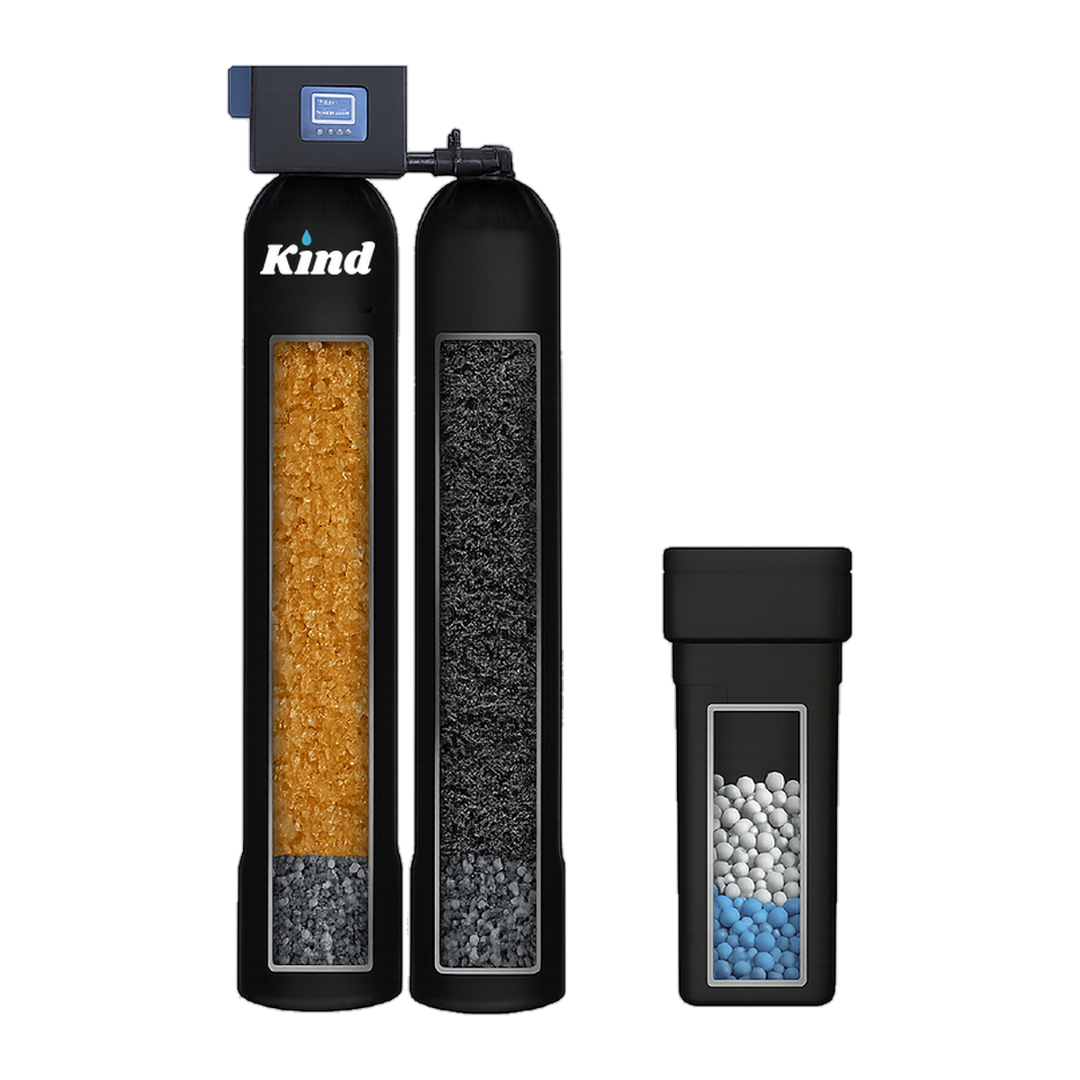
- How air injection works: The tank holds a pocket of compressed air above a media bed, dissolved iron oxidizes as water passes through, and the backwash cycle flushes the trapped particles to the drain.
- Three kinds of iron: Clear-water iron turns orange after sitting, red-water iron arrives already tinted or gritty, and iron bacteria leave a slimy film that calls for disinfecting the well first.
- Filter plus softener: An iron filter does not soften water, and a softener does not filter rust, so on a typical Iowa well the two work as a pair.
An iron filter is a whole-house tank that oxidizes dissolved iron and traps it before that water ever reaches your softener, your fixtures, or your laundry. You need one when your well test comes back above roughly 5 mg/L of iron — Penn State Extension's practical ceiling for what a softener can handle on its own — when the water is already rust-colored at the tap, or when there is an orange slime in the toilet tank. Below that line, a correctly sized softener often handles iron on its own. That is why the honest answer to "do I need an iron filter?" always starts with a test rather than a sales pitch.
Kind Water Co is a family-owned Eastern Iowa water company, started in 2021 by Ryan Brunton and run out of Des Moines. We test and size iron and sulfur systems for rural wells around Cedar Rapids, Marion, Iowa City, Dubuque, Waterloo–Cedar Falls, and the Quad Cities, and the plumbing is handled by licensed local plumbing professionals we vet, schedule, and stand behind.
Two numbers decide whether you need an iron filter
Almost every iron conversation comes down to a pair of published thresholds.
- 0.3 mg/L — the EPA's secondary standard for iron. Secondary standards are aesthetic: color, taste, odor, and staining. Above 0.3 mg/L is roughly where people start noticing orange rings in the toilet, rust-tinted laundry, and a metallic edge to the water.
- 5 mg/L — Penn State Extension's practical ceiling for how much iron a water softener can handle on its own, and only when that iron is still dissolved. Above it, you want a dedicated iron filter installed ahead of the softener.
Manganese has a line of its own: 0.05 mg/L, also an EPA secondary standard. Manganese stains darker than iron — brownish-black rather than orange — and it shows up on the same lab report as iron often enough that we treat the two as a package on any well water treatment job.
Why oxidized iron is hard on a softener
A softener is an ion-exchange bed. Dissolved minerals swap places with sodium on the resin, and periodically the resin is rinsed clean with brine. That mechanism works on iron only while the iron is still dissolved and behaving like a mineral.
Once iron has met oxygen and turned into rust particles, it is no longer something the resin can trade for. It settles into the bed, coats the beads, and gradually chokes the flow — which shows up as a softener that regenerates on schedule and still lets hardness and orange staining through, one of the more common reasons behind a softener that seems to have quit. That is the practical reason behind Penn State Extension's 5 mg/L guidance, and the reason an iron filter goes before the softener rather than after it.
The three kinds of iron you will actually meet
Clear-water iron (dissolved)
Water comes out of the tap perfectly clear, then turns orange or yellow after sitting in a glass or a bathtub for a while. The iron was dissolved and invisible until it met air. This is the type a softener can manage below about 5 mg/L, per Penn State Extension, and the type an iron filter handles easily above it.
Red-water iron (oxidized)
Water is already tinted or gritty the moment it hits the glass. The iron oxidized somewhere upstream — in the aquifer, the casing, or old plumbing — and is arriving as suspended rust particles. A softener is the wrong tool here at any concentration. Filtration is the tool, and stubborn orange staining on fixtures usually traces back to this type.
Iron bacteria (the slimy one)
Not a mineral problem but an organism that feeds on iron and leaves a slimy, stringy orange or brown film — most visibly inside the toilet tank, where nobody scrubs. It often arrives with a musty or swampy smell and can clog the well itself, the pressure tank, and any filter downstream. Iron bacteria typically call for shock disinfection of the well before any equipment goes in, or the new system inherits the problem.
| What you see | Likely type | What it usually means |
|---|---|---|
| Clear at the tap, orange after sitting | Clear-water iron | Softener may be enough under about 5 mg/L (Penn State Extension); filter above it |
| Orange or gritty straight from the tap | Red-water iron | Iron filter, ahead of the softener |
| Slimy orange film that smears when wiped | Iron bacteria | Disinfect the well first, then filter |
| Brown-black specks or gray streaks | Manganese | EPA secondary standard is 0.05 mg/L; usually same system as iron |
How an air-injection iron filter works
The common whole-house design is simpler than it sounds. There is no chemical feed, nothing to mix, and nothing to refill.
- The tank holds a pocket of compressed air at the top, above a bed of filter media.
- Incoming well water passes through that air pocket. Dissolved iron meets oxygen and oxidizes — it turns from invisible to rust-colored right there, inside the tank instead of inside your toilet.
- The media bed below catches the oxidized particles as the water flows through.
- On its backwash cycle, the system reverses flow, flushes the trapped iron to the drain, and draws in a fresh pocket of air for the next run.
Because the oxidizing step happens on purpose and in one place, everything downstream — softener resin, water heater, aerators, washing machine — sees water that has already given up its iron.
Iron, manganese, and sulfur usually travel together
Iowa well owners rarely bring us one complaint. Orange staining, dark specks, and the rotten-egg smell of hydrogen sulfide tend to arrive as a set, because the same reducing conditions in an aquifer that keep iron dissolved also favor manganese and sulfide. The useful part: one properly specified oxidizing filter frequently addresses all three, so the fix is often a single tank rather than three.
Which media goes in that tank depends on your numbers — iron level, manganese level, sulfide, pH, and how hard the well is pumping. That is a sizing decision, not a catalog decision.
Why iron systems are quoted after the test, not before
We publish flat, all-in pricing on everything we can: a softener with reverse osmosis is $2,850, a softener with whole-home carbon filtration is $2,500 (our water softener cost guide breaks that down), our well dual-tank package is $3,650 or $3,950 with a tank RO, a sediment filter is $500, and a tank RO is $897. Every one of those includes equipment, installation, taxes, and lifetime parts, with 0% financing available and $100 off for military and first responders.
Iron and sulfur systems are the exception: they are quoted after your free water test. Media type, tank size, and backwash frequency all follow your iron and manganese numbers and your household's flow rate. Publishing a single price would mean either overselling the well that needs less or undersizing the well that needs more. Neither is a good trade, so we test first and quote second.
What upkeep actually looks like
An air-injection filter runs its programmed backwash cycle without softener salt. Keep any sediment cartridge on its selected replacement schedule, and have the backwash settings and media condition checked if your water or flow changes. Complete private-well service is $250 per visit, twice yearly. Salt, UV lamps, tank swaps and other separately billed consumables or repairs are separate. The service plan explains the visit; we confirm its scope for your actual equipment when booking.
Iron in Eastern Iowa wells
We will not quote you a county-average iron number, because a useful one does not exist. Iron varies well to well — sometimes between neighbors on the same gravel road — depending on depth, casing age, and which formation the well draws from. The only number that matters for sizing is yours.
Hardness is a different story, and it is the reason most well households end up with both pieces of equipment. USGS classifies water above 180 mg/L as very hard — about 10.5 grains per gallon, since 1 grain per gallon equals 17.1 mg/L. USGS sampling of Black Hawk County wells since 1990 shows a median hardness of 271 mg/L, roughly 15.8 grains per gallon, comfortably into that very hard range. Our Iowa water hardness by city guide shows how municipal supplies compare. An iron filter does not soften water, and a softener does not filter rust, so on a typical Iowa well the two work as a pair.
Testing is easier than most people expect. The Iowa DNR recommends testing private wells annually, and its Private Well Grants program funds free county lab testing for private well owners. If your report comes back with something a filter is not the answer to — nitrate, for instance — that is a separate conversation: Iowa State University Extension notes that nitrate is odorless and tasteless and is reduced by reverse osmosis, distillation, or anion exchange, and CDC notes that boiling does not remove chemical contaminants. More on that in our guide to nitrates in Iowa water, and more on wells generally in our well water guide.
Start with the test
Our free in-home test provides hardness, iron and TDS readings you can keep. Bring recent laboratory results so the media and build are selected for your well. For main Des Moines service, call or text (515) 709-4674 or start your Des Moines quote. For Marion / Eastern Iowa, call or text (319) 319-6566 or use the Eastern Iowa quote. Email hello@kindwaterco.com. Your team confirms coverage, scheduling and any travel charge before booking. See county laboratory testing options.
Quoted after your free in-home water test. The right tank size follows your iron, sulfur and manganese numbers, so we do not publish a figure we would have to take back.
- ✓Equipment included
- ✓Professional installation
- ✓Lifetime parts warranty
- ✓Taxes included
0% financing available. The in-home water test is free, with no obligation.
Straight answers.
Do I need an iron filter, or will a water softener handle it?
A softener alone handles iron only up to about 5 mg/L, and only clear-water iron that is still dissolved — that is Penn State Extension's practical ceiling. Above it, or when the water arrives already rust-colored, Kind Water Co sizes a dedicated iron filter to go ahead of the softener on an Eastern Iowa well. Your test decides which.
What does an iron filter cost in Iowa?
Kind Water Co quotes iron and sulfur systems after your free water test instead of publishing a price, because media, tank size, and backwash schedule follow your iron and manganese numbers. Whatever we quote is all-in — equipment, installation, taxes, and lifetime parts — with 0% financing available and $100 off for military and first responders.
Will an iron filter fix a rotten-egg smell?
Often, yes. The same air-injection oxidizing filter that removes iron also addresses hydrogen sulfide, the rotten-egg odor, and manganese, so one tank frequently covers all three on an Iowa well. Media choice depends on your test numbers, which is why Kind Water Co quotes sulfur systems after the free water test rather than before.
How do I know if I have iron bacteria?
Check inside the toilet tank. Iron bacteria leave a slimy, stringy orange or brown film that smears when wiped, unlike the gritty rust particles oxidized iron leaves, and a musty smell often comes with it. A lab test confirms it: the Iowa DNR recommends testing private wells annually and funds free county lab testing through its Private Well Grants program.
Do I still need a softener if I add an iron filter?
Usually, yes. An iron filter removes iron, manganese, and sulfur but does not soften water. Hardness is measured separately: USGS calls water above 180 mg/L — about 10.5 grains per gallon — very hard, and USGS sampling of Black Hawk County wells since 1990 shows a median of 271 mg/L. On most Iowa wells the two work as a pair.
Other systems we install.
Same warranty, same install standard — a different build for a different home.
Not sure which system you need?
Start with a free in-home water test. We'll test your water and recommend exactly the right fit — no pressure, no obligation.
Book my free water test