.webp)

Well Water Sediment Pre-Filter
The cheapest thing on a well that protects everything behind it — sand, silt, grit and rust, caught at the door.
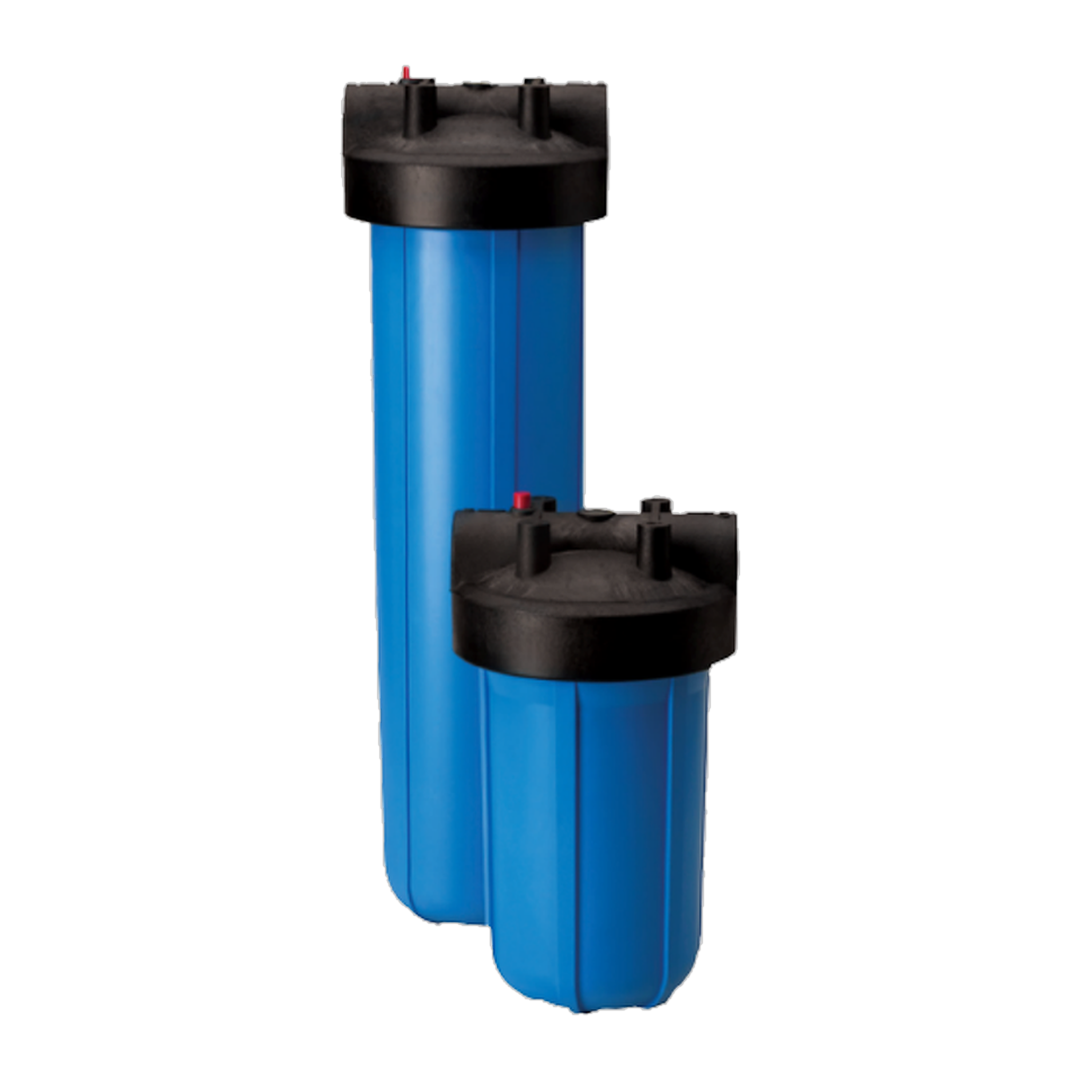



The short answer
- Installed price: A well water sediment pre-filter is $500 installed, all-in with equipment, installation by a licensed local plumbing professional and taxes, and it is the least expensive piece of well equipment.
- Private wells only: It is sold to private-well homes only, because city water reaches the house already settled and filtered at the plant, so a cartridge there would catch almost nothing.
- Where it sits: It goes at the main entry where the well line comes into the house, ahead of the iron filter, the softener, any UV chamber and the water heater.
- Particles only: It catches sand, silt, grit and rust flakes, and it does not treat dissolved iron, hardness, bacteria or nitrate, which pass straight through.
- Sized to the well: Housing size and cartridge micron rating are chosen at the free water test, based on how much sediment the well produces and how much water the household moves at once.
- Cartridge changes: Changing cartridges is a homeowner job on the schedule set at install, and the installer shows the swap at handover: a few minutes with a housing wrench.
A well water sediment pre-filter is $500 installed from Kind Water Co, and we sell it to one kind of home: a house in Eastern Iowa that draws from its own private well. It is the least expensive piece of equipment we put on a well and the first one the water meets: a cartridge housing at the main line that catches sand, silt, grit and rust flakes before they reach the softener, the iron filter, the water heater and every faucet. It does not treat dissolved iron, hardness, bacteria or nitrate, and we will not sell it to a city-water home.
What a well carries, and how you notice it
Iowa State University Extension estimates that roughly 230,000 Iowans get their water from private wells, and every one of those wells pulls from sand, gravel or rock rather than a treatment plant, so some of that ground comes along for the ride. Sediment is the catch-all word for the solid particles in well water: fine sand and silt from the aquifer, grit stirred up when the pump cycles, and rust flakes shed by an aging casing or old iron pipe. None of it is dissolved, which is why a physical barrier works on it and why the first stage on a well is a filter rather than a tank.
Homeowners rarely say the word sediment; they describe what it does. Grit in the faucet aerators: unscrew the screen on a tap and there is a small pile of sand or dark flecks behind it, and cleaning it fixes the weak flow until it fills again. Cloudy water right after the pump runs: a glass filled after a shower or a load of laundry comes out hazy, then clears as the particles settle. A gritty toilet tank: loose sand or fine silt along the bottom means the same material is landing in the water heater, the washing machine and the dishwasher. If what you find in the tank is a slimy orange-brown film rather than loose grit, that is a different problem, covered further down this page.
The one spot it belongs, and everything it stands in front of
A sediment pre-filter goes at the main entry, where the well line comes into the house, ahead of every other tank. On a well that means before the iron filter, before the softener, before the UV chamber if there is one, and long before the water heater. The whole layered build is on our well water treatment page.
What it protects is a short list with a long price tag. Grit that reaches the softener packs into the resin bed and cuts the flow through it; the softener keeps cycling, but the water coming out is not soft. An iron filter downstream meets the same grit. Faucet cartridges, shower valves and appliance fill valves wear from it, and water heaters collect it as a layer at the bottom. An under-sink tank reverse osmosis system has its own small sediment stage, built to polish already-clear water, not to take a well’s whole load. It is the piece that lets everything behind it work as designed, which is why it goes in first on our well dual-tank system.
$500, and the cartridges after it
The $500 is the whole number. Tax is inside it, nothing is added after the install, and the table below is the full story of what the money buys, what stays a homeowner job, and what this filter is not for.
| Line item | How it is handled |
|---|---|
| Sediment filter housing and cartridge | Included |
| Housing size and cartridge micron rating, chosen at the free water test | Included |
| Installation by a licensed local plumbing professional | Included |
| Taxes | Included |
| Warranty: lifetime on parts, one year on labor | Included |
| Cartridge changes after install | Homeowner job on the schedule set at install; the installer shows the swap |
| Use on a city-water home | Not sold; a private well is its only use |
| Dissolved iron, hardness, bacteria, nitrate | Not what it does; separate equipment, sized after the test |
| Well pump, screen, cap or casing work | Not ours; a licensed well contractor |
Military members and first responders take $100 off the $500, and if you would rather not pay it all at once, 0% financing is available on approved credit through a third-party lender.
Sized to the well and the household, not pulled off a shelf
There is no single sediment filter. The housing size and the cartridge’s micron rating — how fine a particle it stops — are chosen for two things: how much sediment the well produces and how much water the household moves at once. A well that sheds a little fine silt and a well that throws sand every time the pump kicks on need different cartridges, and a house with four bathrooms running at breakfast needs a bigger housing than a two-person house, because a cartridge too small for the flow shows up as a weak shower. We will not print a micron number or a housing size here, because the right one is the one that fits your well, and we do not know your well until we have seen the water.
Cartridge changes follow the same logic. This is the most hands-on piece of a well system, and how often it needs attention depends entirely on how much grit the well produces. We set the schedule at install and show you the swap at handover so it is a homeowner job: a few minutes, no tools beyond the housing wrench. A cartridge left in past its time slowly chokes the flow to the whole house, and the first place most people notice is the shower.
Dissolved iron, hardness, bacteria and nitrate pass straight through
A sediment filter is inexpensive, and it is tempting to hope it does more than it does. It removes particles. It does not remove anything dissolved in the water.
- Dissolved iron and manganese. The iron that stains a well home is usually still dissolved when it comes up the well: clear in the glass, orange only after it has sat in the toilet tank or on the laundry long enough to meet air. Water that clear goes through a sediment cartridge as if the cartridge were not there. What the cartridge does catch is rust that has already formed, flakes off a casing or an old pipe. Which iron needs which tank is on our iron filters page.
- Hardness. Calcium and magnesium are dissolved minerals. Scale on fixtures and film on the shower door are a softener’s work.
- Bacteria. A cartridge is not a disinfection step. If a lab test finds coliform, the well gets disinfected first; our page on well water bacteria in Iowa covers what that involves.
- Nitrate. Nitrate is dissolved, so a sediment cartridge has no effect on it at all. The county lab result, not this filter, is where that conversation starts.
The Iowa DNR recommends testing a private well every year for coliform bacteria and nitrate, and Iowa’s Private Well Grants program funds free county lab testing; our guide to free well water testing in Iowa explains how to request it. That lab report is where the dissolved questions get answered.
Orange slime and a struggling pump are someone else’s job first
Two well problems look like sediment problems and are not. The first is the slimy orange-brown film in the toilet tank: that is iron bacteria, not loose rust, and a cartridge cannot strain out a film that grows. The fix is to shock-chlorinate the well first; a cartridge installed ahead of that just clogs on the same slime, and so does every tank behind it.
The second is the well itself: the pump, the screen, the cap and the casing. A well that suddenly starts pumping sand, loses pressure or sputters air is usually telling you something about the well rather than the water. A filter downstream will catch the sand but will not fix why it is there, and it will need constant cartridge changes until someone does. That is a licensed well contractor’s work. We do not service well pumps, pressure tanks, screens, caps or casings, and we would rather say so up front than sell a filter to a well that needs a repair.
City water already arrives without the grit
City water reaches the house already settled and filtered at the plant. On a city build the whole-home carbon tank rinses itself on a schedule, so a cartridge in front of it would catch almost nothing, and we do not sell one there.
Find out first whether the well needs it
Start with the free in-home hardness, iron, TDS and nitrate screening test, plus photos or a sample of the particles your well produces. We review the entry point and downstream equipment before selecting a sediment filter. For main Des Moines service, call or text (515) 709-4674 or start your Des Moines quote. For Marion / Eastern Iowa, call or text (319) 319-6566 or use the Eastern Iowa quote. Email hello@kindwaterco.com. Your team confirms coverage, scheduling and any travel charge before booking.
- ✓Equipment included
- ✓Professional installation
- ✓Lifetime parts warranty
- ✓Taxes included
0% financing available. The in-home water test is free, with no obligation.
Straight answers.
Why is my well water cloudy right after the pump runs?
Haze that shows up while the pump is running and drops out of a glass after a few minutes is suspended sediment: sand, silt or rust particles that came up the well with the water. A sediment pre-filter at the main entry stops those particles before they reach the house. Kind Water Co installs one on Eastern Iowa wells for $500, all-in with installation and taxes. If the haze never clears, or it started suddenly, the well itself may need a look from a licensed well contractor.
How often does a well sediment filter cartridge need to be changed?
It depends on the well, not the calendar. Some wells barely dirty a cartridge, while others load one up quickly because the pump stirs up sand with every cycle. Kind Water Co sets the interval at install after seeing what your well actually pushes, and the installer walks you through the swap so it is a homeowner job. Put it off and the first sign is usually weaker water pressure everywhere in the house.
Do I need a sediment filter if I already have a water softener on my well?
If the well pushes any grit, yes, and it goes in front of the softener. A softener rinses its resin with brine on a schedule, but that rinse is built to carry off dissolved hardness, not sand; grit is what the softener cannot rinse out. The $500 pre-filter is the lowest-priced piece of well equipment Kind Water Co installs, and it sits ahead of the softener, the iron filter and the water heater. On city water, a softener does not normally need one.
Can a sediment filter remove iron from well water?
Only the iron that has already turned into rust particles. Iron that is still dissolved comes up the well clear and goes straight through a sediment cartridge, then turns orange later in the toilet tank or on the laundry. Penn State Extension puts the ceiling for softening alone at about 5 mg/L of dissolved iron; past that, Kind Water Co sizes a dedicated iron filter after a free water test. The sediment filter protects that equipment from grit. It does not replace it.
Other systems we install.
Same warranty, same install standard — a different build for a different home.
Not sure which system you need?
Start with a free in-home water test. We'll test your water and recommend exactly the right fit — no pressure, no obligation.
Book my free water test