.webp)

Tank Reverse Osmosis System
Stored reverse osmosis on its own kitchen faucet — the only RO we put on a private well, because a tankless unit loses pressure there.



The short answer
- Installed price: The tank reverse osmosis system is $897 installed, all-in with equipment, installation by a licensed local plumbing professional, taxes, and lifetime parts, five years media and one year labor.
- Storage tank capacity: The tank holds 4.8 gallons with about 2.5 to 3 of those usable, and the membrane starts refilling the moment you draw, so the working supply rolls over.
- Certification and listing: The unit is certified to NSF/ANSI 58 by IAPMO R&T under file WC-14468, the certificate's claim is TDS reduction, and the standard requires at least 75 percent.
- 27 versus 100: The listing records a certified 27.05 gallons per day for the whole assembled system, while the membrane element's own rating is 100 gallons per day; both are true.
- Why wells store water: Wells run high in dissolved solids, so a stored supply lets the membrane refill in the background instead of making a glass of water at the speed you pour one.
- Inside a well build: Added to the well dual-tank system the tank RO is $300 rather than $897, and on a well a $500 pre-sediment filter goes in ahead of it.
Our tank reverse osmosis system is $897 installed in Eastern Iowa, and it is the drinking-water system we put on private wells. It stores treated water so the membrane never has to keep pace with the faucet, which is the whole reason it is the one we put on a well; it is also the pick for city homes that would rather pour from a stored supply. This page covers the unit itself. The general case for reverse osmosis at the kitchen tap, what it removes and how it tastes, is on our reverse osmosis drinking water page.
What goes into the cabinet
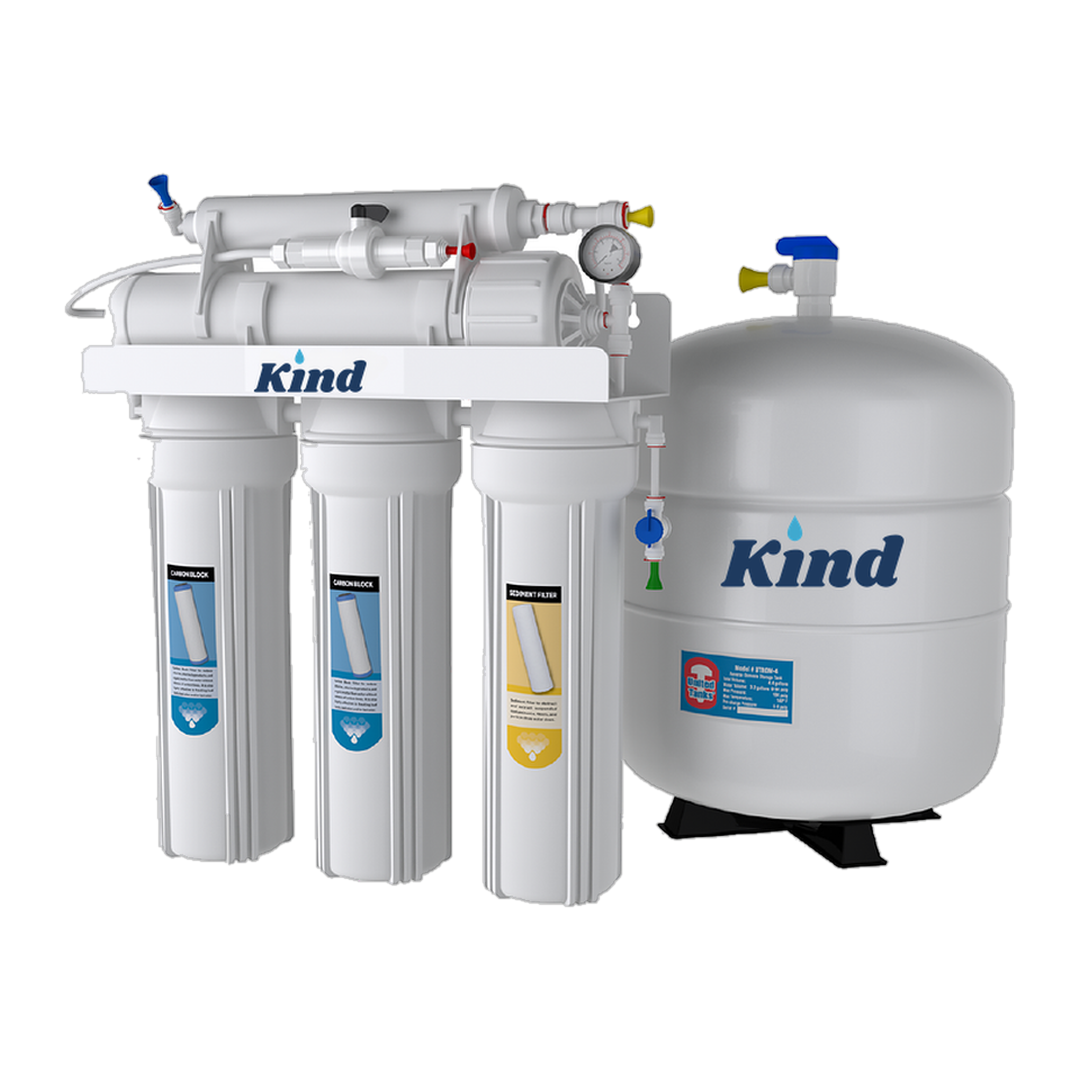
Three pieces: a filter assembly mounted on the cabinet wall, a storage tank on the cabinet floor beside it, and a dedicated faucet at the sink deck. Seven stages are mounted in the wall assembly, including the prefilters, the 100-gallon-per-day membrane, a polishing stage and the alkaline mineral filter, which comes standard on every unit we install and puts a small amount of mineral back into the finished water. What each stage does is on the reverse osmosis drinking water page above.
The tank is the part people ask about. It holds 4.8 gallons, and about 2.5 to 3 of those are usable. The tank carries an air charge that pushes the water out to the faucet, and as the tank empties the air expands and the last gallon or two stays behind at low pressure. The moment you draw a pitcher, the membrane starts refilling the tank, so the working supply is a rolling two and a half gallons rather than a fixed one. When the tank is full, an automatic shut-off valve stops production; open the faucet and it starts again.
Why a stored supply is the right build on a well
It is the only reverse osmosis we install on a well; why the tankless unit stays off wells is on that unit’s page. With a tank, the membrane refills in the background and the faucet pours from the reserve, so the membrane is never asked to make a glass of water at the speed you pour one. It can take its time on the heavier dissolved-solids load a well delivers, because the tank, not the membrane, is what answers the faucet. A well running high TDS, or a prefilter partway through its life, slows the refill; you notice it only if the tank runs dry before the membrane catches up, and in a household drinking a few gallons a day it rarely does.
That is the whole argument for storage on a well, and it is a mechanical one rather than a sales one. The reserve is what lets a membrane on well water behave the way a membrane on softened city water does at the tap.
27 gallons on the certificate, 100 on the membrane: both are true
Our tank unit is certified to NSF/ANSI 58 by IAPMO R&T, an accredited certifier that tests to the same standard NSF International does. The listing is file WC-14468, in the category “Systems with Storage Tank and Automatic Shut-off Valve,” and the claim on the certificate is TDS reduction. NSF/ANSI 58 will not certify a reverse osmosis system unless it reduces total dissolved solids by at least 75 percent, so a listing under that standard is a statement about what the unit was measured doing, not a sticker.
The listing records a certified daily production rate of 27.05 gallons per day under the standard’s test conditions; the membrane’s own rating is 100 gallons per day. The two numbers measure different things. The membrane rating is what the membrane element can produce under its maker’s conditions; the certified rate is what the whole assembled system, tank and shut-off valve included, produced when the certifier ran it under the conditions the standard sets. Neither is the number that matters in your kitchen. Most households drink and cook with two to five gallons a day, so either figure is many times what the family will draw, and the storage tank is sized to that daily use, not to the membrane.
Its place in a well build
Grit and iron are what shorten a membrane’s life, so on a well a sediment pre-filter, $500, goes in ahead of it, and the RO is the last piece of the build. How the layered build goes together, and in what order, is on our well water treatment page. Where a well also needs iron or sulfur equipment, we put a number on that after the free water test, not before, because the build depends on what the test shows.
Owning this unit on a well costs less inside the well build than on its own, and that math is in the table below: added to our well dual-tank system, the tank RO is $300 rather than $897.
Bring the current laboratory nitrate result when drinking-water treatment is part of your well plan. Reverse osmosis is one of the nitrate-treatment technologies identified by EPA. Our tank unit’s listed certified claim is TDS reduction, not nitrate; for nitrate, we have your water tested for nitrate and arsenic first, choose the system from the lab results and test again after installation. We review the appropriate model and follow-up water testing with you. See the nitrate guide.
What $897 buys, and what the well build adds
The first five rows are inside the price. The rest are extra, and each is a fixed number rather than a surprise.
| Item | Included or extra |
|---|---|
| Seven-stage tank RO unit, 4.8-gallon storage tank and dedicated kitchen faucet | Included |
| Alkaline mineral filter | Included as standard |
| Installation by a licensed local plumbing professional | Included |
| Taxes | Included |
| Warranty: lifetime parts, 5 years media, 1 year labor | Included |
| Added to the well dual-tank system | $3,950 total, $300 over the $3,650 build |
| Pre-sediment filter, well water only | $500 extra |
| Refrigerator or ice-maker line | $350 extra; not possible when the sink is in an island |
| Annual service visit: all RO filters, water test, system check | $199 per year |
Financing is available at 0% on approved credit through a third-party lender, and military members and first responders take $100 off. The before-and-after water test that backs every install is spelled out on our guarantee page.
Owning it: $199 a year
For city-water homes, optional annual service is $199 and includes the RO filters, a water test and system check. Complete private-well systems follow the separate $250-per-visit well plan, twice yearly. Salt, UV lamps, tank swaps and other separately billed work are outside that scheduled visit. We confirm the model and service scope when booking. See the maintenance plans and RO service options.
When a city kitchen picks the tank
The tank unit is not only a well product. On city water either of our systems works, and a city household picks the tank when it wants a stored supply: the unit runs on household water pressure and needs no powered outlet under the sink, it works with a refrigerator or ice-maker line where the layout allows, and it pours from the reserve rather than at the membrane’s pace, because the tank is doing the pouring. What it asks in return is cabinet floor space for the tank. The cabinet-space trade is on the tankless page.
Three things the tank asks for, on either supply:
- Cabinet floor space for a 4.8-gallon storage tank beside the filter assembly.
- A drain tie-in under the sink, which the licensed plumbing professional makes on install day.
- No outlet. The tank runs on the pressure already in your cold line.
Size it for your well, or your cabinet
The in-home hardness, iron and TDS test is free. For a well, have recent county laboratory results ready so the equipment plan uses both kinds of information. For main Des Moines service, call or text (515) 709-4674 or start your Des Moines quote. For Marion / Eastern Iowa, call or text (319) 319-6566 or use the Eastern Iowa quote. Email hello@kindwaterco.com. Your team confirms coverage, scheduling and any travel charge before booking.
- ✓Equipment included
- ✓Professional installation
- ✓Lifetime parts warranty
- ✓Taxes included
0% financing available. The in-home water test is free, with no obligation.
Straight answers.
How much water does a tank reverse osmosis system hold, and is that enough for a family?
The tank on our unit holds 4.8 gallons, with about 2.5 to 3 gallons usable because an internal air charge pushes the water out and the last portion stays behind at low pressure. The membrane begins refilling the tank as soon as you draw from it, so the supply rolls over through the day. Most households drink and cook with two to five gallons a day, which the unit covers comfortably.
Why does the certificate say 27 gallons a day when the membrane is rated for 100?
Because they measure different things. The 100-gallon-per-day figure is the membrane element’s own rating. The 27.05 gallons per day on the IAPMO R&T listing is what the whole assembled system produced when the certifier tested it under the conditions NSF/ANSI 58 sets. Both are true. Most households drink and cook with two to five gallons a day, so either number is several times what the family will actually draw.
What happens when the storage tank runs empty?
The faucet slows to whatever the membrane can make at that moment, and then the tank fills back up in the background. The membrane starts refilling as soon as you draw, so in a household using a few gallons a day the tank rarely runs dry. On a well, high dissolved solids or a prefilter partway through its life slow the refill, which is one reason the annual filter change matters on a well home.
Is the tank reverse osmosis system certified, and by whom?
Yes. Our tank unit is certified to NSF/ANSI 58 by IAPMO R&T under file WC-14468, listed as a system with storage tank and automatic shut-off valve. IAPMO R&T is an accredited certifier that tests to the same standard NSF International does. The claim on the certificate is TDS reduction, and the standard requires a system to reduce total dissolved solids by at least 75 percent before it can be certified.
Other systems we install.
Same warranty, same install standard — a different build for a different home.

Not sure which system you need?
Start with a free in-home water test. We'll test your water and recommend exactly the right fit — no pressure, no obligation.
Book my free water test